China has become a major production base for filament machinery, serving textile, industrial, and specialty fiber markets. This guide introduces China’s top Automatic Filament Equipment manufacturers through practical, measurable criteria. It considers machine design, production experience, material compatibility, automation levels, and after-sales support.
A reliable manufacturer should explain each process clearly. Buyers may need equipment for spinning, drawing, winding, texturing, or complete filament production lines. Details matter. Servo motors, tension control, temperature stability, and winding accuracy can affect output quality. Factory visits, sample testing, and technical demonstrations often reveal more than polished brochures. That point deserves attention.
The evaluation also considers certifications, export records, spare-part availability, and commissioning support. Experienced suppliers usually provide layout drawings, operating guidance, maintenance schedules, and training for local teams. Their engineers should understand common problems, including uneven denier, yarn breaks, unstable tension, and excessive energy use. These issues can appear after installation, not during a sales meeting.
No supplier is perfect. Some companies offer impressive specifications but limited field support. Others provide dependable service but fewer customization options. This guide therefore avoids relying only on company size or marketing language. It focuses on evidence, application fit, and long-term operating value. Readers should verify claims independently before signing a contract. Prices, delivery times, and compliance requirements can change by project and destination. Careful comparison remains essential when selecting Automatic Filament Equipment for a modern production facility.
Automatic filament equipment refers to integrated machinery that produces, stretches, monitors, and winds continuous synthetic filaments. It can control temperature, tension, speed, and winding pressure during production. These functions help maintain stable diameter, strength, and surface quality. Operators can also review sensor data through a central control panel. This reduces repetitive manual adjustments and supports safer, more consistent workflows.
Tips: Check tension sensors before each shift. Keep spinneret areas clean. Record temperature changes and winding defects. A small calibration error may create uneven packages across an entire production run. Good maintenance matters.
In practical use, automatic filament equipment connects material handling with real-time quality control. It can stop or adjust production when tension rises unexpectedly. This protects downstream processes such as weaving, knitting, and technical fabric production. Experienced technicians still need to inspect samples by hand. Digital readings are useful, but they are not always complete. Humidity, recycled feedstock, and worn guides can influence results. I have found that clear operating records often reveal problems earlier than alarms. However, equipment settings should not be copied blindly between factories. Each polymer, line speed, and final application may require different conditions. That part is easy to underestimate.
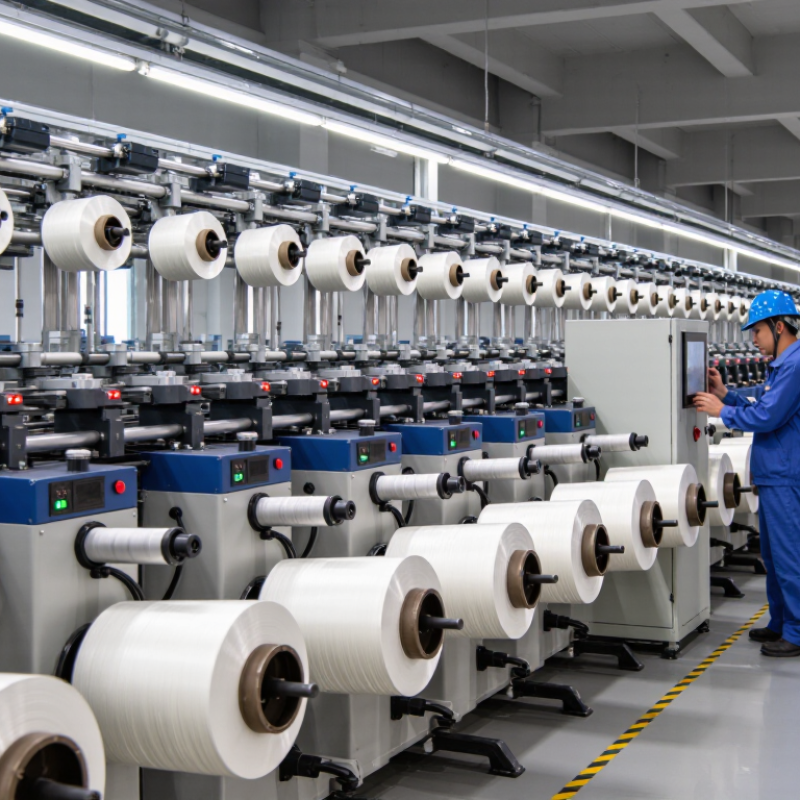
China’s automatic filament equipment manufacturing landscape is expanding with strong process integration. Machines now combine spinning, winding, tension control, and online quality monitoring. This reduces manual adjustment and supports stable output across long production runs.
Textile Exchange’s Materials Market Report 2024 states that polyester supplied about 57% of global fiber production in 2023. China remains a central production base for this material. National industry data also placed China’s chemical fiber output above 70 million tonnes in 2023. These figures explain the demand for faster and more precise filament equipment. In factory audits, automatic tension control often proves more valuable than headline speed. It helps reduce uneven denier, broken filaments, and wasted polymer. Yet the landscape is not flawless. Some facilities still purchase high-speed lines before checking maintenance skills, energy use, and spare-part access.
Tips: Compare actual energy consumption, not only rated capacity. Check trial records for winding consistency. Ask whether software supports local production data systems. A slower line may deliver better uptime.
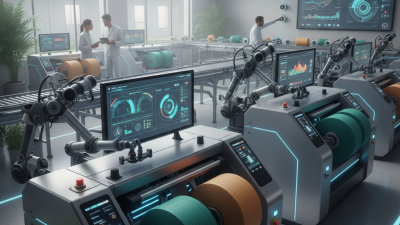
Manufacturers are also adding digital dashboards and predictive maintenance functions. These tools can identify vibration, temperature drift, and winding defects earlier. However, data quality remains a weakness in some plants. Sensors cannot correct poor calibration. Buyers should request verified test results, operator training plans, and service response times before installation.
Automatic filament lines depend on coordinated control, not merely faster extrusion. A gravimetric feeder meters polymer pellets, colorant, and additives by mass. This reduces batch variation before melting begins. The extrusion barrel then uses multiple temperature zones and servo-driven screws. Grand View Research valued the global plastic extrusion market at about USD 247 billion in 2023. That scale explains why precise, repeatable equipment matters to Chinese manufacturers serving export markets. Market size is not proof of quality.
Melt filtration removes gels and unmelted particles before polymer reaches the die. A laser gauge checks filament diameter continuously, often at several hundred readings per second. Closed-loop control can adjust haul-off speed when diameter drifts. For 1.75 mm filament, a small error may cause feeding jams or weak printed layers. The 2024 Wohlers Report valued the additive manufacturing industry at USD 20.035 billion in 2023, reflecting stronger demand for stable feedstock. Yet demand alone does not guarantee reliable production.
After cooling, air knives and water baths stabilize the strand before precision winding. Tension sensors prevent loose coils, while barcode records link each spool to its process history. The International Energy Agency reports that industry uses roughly 37% of global final energy. Efficient heaters and heat recovery can reduce waste, although savings vary by line design. In practice, sensor calibration is often the weak point. A perfect screen cannot correct a dirty die. Manufacturers should publish tolerance data, test methods, and failure rates, not only output speed.
China Top Automatic Filament Equipment Manufacturers
Leading Chinese manufacturers of automatic filament equipment serve textile, industrial, and technical material producers. Their factories commonly build polymer extrusion, melt spinning, drawing, annealing, and winding systems. Many suppliers offer complete production lines, not only individual machines. This can simplify installation and reduce communication gaps between process stages.
A typical automatic line includes gravimetric feeding, temperature-controlled extruders, spinnerets, godet rollers, and precision winders. Servo drives help maintain stable tension during high-speed operation. Digital control panels record temperature, pressure, speed, and production alarms. Some manufacturers also provide online monitoring, automatic doffing, and recipe management for repeated production. These features matter when operators handle several lines during a shift.
Equipment capability still varies between suppliers. A machine designed for polyester filament may need changes for nylon, polypropylene, or specialty polymers. Buyers should inspect trial samples, energy data, maintenance access, and spare-part availability. Published output figures can look impressive. Real performance may change with polymer quality, room temperature, and operator experience. Factory visits and supervised acceptance tests provide stronger evidence than brochures. I would also question systems that promise complete automation without explaining manual recovery steps. Even advanced equipment needs skilled adjustment when yarn breaks, filters clog, or winding tension drifts.
| Equipment Category | Primary Function | Typical Production Capacity | Compatible Filament Materials | Automatic Functions | Control and Monitoring | Typical Dimensional Accuracy | Common Applications |
|---|---|---|---|---|---|---|---|
| Single-Screw Filament Extrusion Line | Melts, homogenizes, filters, and continuously extrudes thermoplastic filament. | Approximately 5–30 kg/h for standard laboratory and commercial lines. | PLA, ABS, PETG, TPU, PA, PC, PP, and selected filled compounds. | Automatic feeding, temperature regulation, extrusion-speed control, cooling, diameter correction, and winding. | PLC-based control with touchscreen interface, melt-pressure monitoring, temperature alarms, and production-data recording. | Commonly controlled within ±0.03–0.05 mm for 1.75 mm filament when properly calibrated. | Desktop 3D-printing filament, engineering polymer filament, and customized compound filament. |
| Twin-Screw Compounding and Filament Line | Compounds polymers with pigments, mineral fillers, fibers, flame retardants, or performance additives before filament forming. | Typically 10–80 kg/h, depending on screw diameter, formulation, and material residence time. | PLA, ABS, PET, PA, PC, PP, bio-based polymers, wood-filled compounds, and mineral-filled compounds. | Gravimetric or volumetric dosing, recipe management, automatic strand cooling, pelletizing or direct filament forming, and fault protection. | PLC or industrial computer control with torque, pressure, temperature, feeder-rate, and motor-load monitoring. | Usually ±0.05–0.10 mm for filament production, subject to formulation and cooling conditions. | Functional, reinforced, colored, recycled, and specialty 3D-printing filament. |
| High-Speed Filament Extrusion System | Produces filament at elevated line speeds while maintaining stable melt flow and diameter control. | Commonly 20–60 kg/h for commercial-scale thermoplastic filament production. | PLA, PETG, ABS, HIPS, PA, PC, and other thermoplastics with suitable melt stability. | Automatic line-speed synchronization, closed-loop diameter adjustment, multi-zone cooling, and automatic spool change options. | Laser or optical diameter measurement, real-time trend display, alarm logging, and recipe-based process control. | Closed-loop systems can target approximately ±0.02–0.05 mm under stable operating conditions. | High-volume production of standard 1.75 mm and 2.85 mm filament. |
| Water-Cooling and Calibration Unit | Cools and stabilizes extruded filament while helping maintain roundness and dimensional consistency. | Designed for line speeds from approximately 10 to 100 m/min, depending on material and diameter. | Most melt-processable filament polymers, including flexible and engineering-grade materials. | Automatic water-temperature control, circulation, level monitoring, haul-off synchronization, and cooling-zone adjustment. | Temperature sensors, flow meters, water-level alarms, and integrated line-speed communication. | Supports production control within approximately ±0.03–0.10 mm, depending on the complete line configuration. | Diameter stabilization for filament extrusion lines and specialty profile production. |
| Laser Diameter Measurement and Closed-Loop Control | Measures filament diameter and ovality without contact and sends correction signals to the extrusion or haul-off system. | Suitable for continuous lines operating at low, medium, or high production speeds. | Opaque, translucent, and selected transparent thermoplastic filaments, subject to sensor specifications. | Automatic diameter correction, tolerance alarms, data logging, reject marking, and process feedback. | Digital display of diameter, ovality, statistical trends, upper and lower limits, and production records. | Measurement resolution may reach the micrometer range; practical process accuracy depends on material and line stability. | Quality control for 1.75 mm, 2.85 mm, and other customized filament diameters. |
| Automatic Filament Winding and Spooling Machine | Winds finished filament onto spools with controlled tension, traverse movement, and package formation. | Commonly supports 0.25–2.5 kg spool formats and line speeds of approximately 20–100 m/min. | Rigid, flexible, filled, and engineering thermoplastic filaments. | Automatic tension control, traverse synchronization, length or weight-based stopping, spool detection, and optional automatic spool change. | Servo-drive control, tension monitoring, meter counting, spool status detection, and fault alarms. | Spool winding accuracy is generally controlled by tension, traverse pitch, and package geometry rather than filament diameter alone. | Retail spools, industrial spools, sample reels, and continuous filament packaging. |
| Drying and Dehumidifying System | Removes moisture from hygroscopic polymers before extrusion to reduce bubbles, brittleness, and surface defects. | Typical hopper capacities range from approximately 25 to 300 kg, depending on production scale. | PA, PETG, PC, ABS, TPU, PEEK, and other moisture-sensitive polymers. | Automatic temperature control, dew-point regulation, material-level monitoring, timed drying cycles, and conveying. | Temperature and dew-point display, alarm functions, energy-saving modes, and batch-status monitoring. | Moisture performance depends on resin type; many engineering polymers require moisture levels below 0.02% before processing. | Pre-treatment of engineering polymers and stable production of high-quality filament. |
| Filament Laser Marking and Packaging Line | Applies product information and packages filament after winding and quality inspection. | Typically 10–40 spools per minute for automated labeling and packaging configurations. | Standard thermoplastic filament spools and selected specialty materials. | Automatic labeling, barcode printing, spool detection, weighing, sealing, carton forming, and batch-code generation. | PLC control with barcode verification, weight checking, packaging-count records, and alarm management. | Packaging weight tolerances are commonly configured according to the target spool weight and local legal requirements. | Retail packaging, export packaging, inventory identification, and traceable batch production. |
| Online Filament Inspection and Data Management System | Combines dimensional inspection, surface monitoring, process alarms, and production records. | Designed for continuous monitoring throughout the entire extrusion and winding process. | Standard, flexible, filled, colored, recycled, and engineering-grade filament. | Automatic defect detection, tolerance classification, batch tracking, production reports, and reject or alarm signaling. | Industrial computer or PLC interface with historical trends, recipe storage, user permissions, and data export. | Inspection limits are configurable for diameter, ovality, surface defects, length, and weight. | Quality assurance, process optimization, supplier audits, and production traceability. |

The specifications shown are representative capability ranges for automatic filament-production equipment commonly offered by Chinese machinery suppliers. Actual performance depends on polymer formulation, screw design, line configuration, cooling conditions, calibration, and operating parameters.
A factory’s brochure is only a starting point. Evaluate the production line, not the sales language. Ask how the machine handles your polymer, filament diameter, and target speed. Request a live trial using material similar to yours. Watch tension changes at the winder. Small fluctuations can reveal weak control logic. Measure diameter stability at several points, not one convenient sample. Good testing leaves records.
An experienced manufacturer should explain extrusion temperature zones, cooling design, puller calibration, and winding accuracy. Their engineers should discuss causes, not merely promise perfect output. Check the control interface with an operator who will use it daily. Can a technician adjust settings without hidden menus? That detail matters. Review maintenance schedules, spare-part availability, training, and remote support response times. Ask for references from installations with comparable capacity. Vague answers deserve careful notes.
Reliability also depends on documentation. Look for clear drawings, alarm descriptions, electrical data, and acceptance-test procedures. A proper supplier should disclose tolerances and expected energy use. Factory visits help verify assembly quality, inspection routines, and actual testing equipment. I would still avoid judging from a polished showroom; clean floors cannot prove long-term performance. One overlooked issue is after-sales ownership. If every problem moves between departments, downtime becomes expensive. Ask who decides, who responds, and who supplies the replacement part. No evaluation is flawless. My own checklists sometimes miss operator comfort until production begins. That is worth correcting early.