Leave Your Message
Choosing an Automatic Spunlace Line in 2026 requires more than comparing speed and purchase price. The right system must match your fiber blend, product weight, web width, and target markets. A line producing soft wipes may need different hydroentanglement settings than one making medical or filtration materials. Small differences in nozzle design, water pressure, and drying capacity can change strength, softness, and energy use.
This guide examines practical selection points from an engineering and production perspective. It considers carding performance, cross-lapping stability, hydroentanglement control, dewatering, drying, winding, automation, and quality tracking. Experienced buyers should also review water treatment, power consumption, operator access, spare parts, and service response. A factory visit can reveal details that brochures often hide, such as floor vibration, cleaning time, and the distance between control panels and moving equipment.
A perfect specification rarely exists. Some performance estimates remain uncertain until fiber trials and factory acceptance tests are completed. Buyers should request verified data, sample rolls, test reports, and clear warranty terms. They should also compare total operating cost, not only the initial quotation. The cheapest line may consume more energy or require longer changeovers. That can quietly reduce profit.
The following sections provide a structured way to compare suppliers and technologies. They also highlight questions worth asking before signing a contract. Careful evaluation supports safer investment, stable quality, and more reliable long-term production. Yet judgment still matters. Numbers need context. Perhaps that is the most overlooked point.
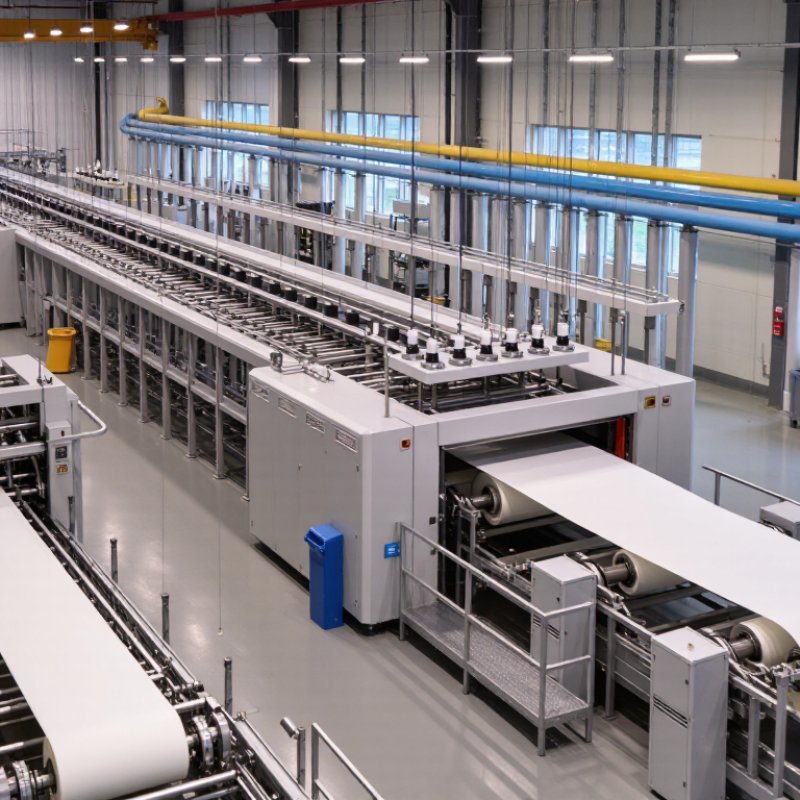
An automatic spunlace line converts loose fibers into soft, bonded nonwoven fabric. It commonly processes viscose, polyester, cotton, or blended fibers. The line does not use traditional weaving or chemical bonding.
The process begins with fiber opening and blending. A carding machine forms a uniform web. Crosslapping then builds the required width and basis weight. The web moves beneath fine, high-pressure water jets. These jets entangle the fibers through repeated impact. The material becomes stronger while retaining a textile-like surface.
Water removal follows.
Vacuum equipment extracts much of the moisture before drying. Heated cylinders or air systems reduce the remaining water. An automatic control system monitors tension, speed, moisture, and fabric weight. Proper synchronization prevents wrinkles and uneven bonding. In practical operation, small changes in fiber moisture can affect web stability. I have seen minor settings create visible streaks across an otherwise acceptable roll.
When choosing a line in 2026, examine the full process rather than one machine. Check jet pressure control, filtration capacity, drying efficiency, and cleaning access. Reliable sensors matter because operators cannot inspect every meter manually. Energy use also deserves close attention, especially during continuous production. Some specifications may look impressive on paper but perform differently with local fibers. Trial production is wiser than relying only on written claims. The right line should support consistent quality, manageable maintenance, and realistic production targets.
| Selection Dimension | Typical Industry Range or Option | What It Means | Recommended Consideration |
|---|---|---|---|
| Production Principle | Hydroentanglement | High-pressure water jets entangle loose fibers to form a coherent nonwoven web without thermal bonding. | Choose the process according to the required softness, absorbency, strength, and end use. |
| Usable Fiber Types | Viscose, polyester, cotton, lyocell, polypropylene, and fiber blends | Fiber selection influences absorbency, strength, biodegradability, cost, and drying requirements. | Confirm fiber compatibility with the opening, carding, web-forming, and hydroentanglement sections. |
| Finished Product Width | Approximately 1.6–3.2 m, depending on the line configuration | The working width determines output capacity and the maximum usable product width. | Select a width based on product demand, available factory space, and downstream slitting needs. |
| Basis Weight | Approximately 25–150 g/m² for many common applications | Basis weight affects fabric thickness, coverage, absorbency, strength, and material consumption. | Make sure the carding and web-forming systems can maintain uniformity across the target weight range. |
| Line Speed | Approximately 80–250 m/min, depending on product and process settings | Higher speed can increase output but may reduce web stability or quality if the process is not properly balanced. | Compare usable output at the required basis weight rather than relying only on maximum speed. |
| Hydroentanglement Pressure | Commonly about 30–200 bar, adjusted by product structure | Water pressure and jet arrangement control fiber entanglement, fabric strength, surface pattern, and softness. | Use adjustable pressure zones to support different product specifications and fiber blends. |
| Water Filtration and Recirculation | Multi-stage filtration with approximately 95–98% water reuse potential | Filtration removes loose fibers and contaminants before process water is returned to the hydroentanglement system. | Evaluate filtration accuracy, pump protection, wastewater treatment, and water-quality monitoring. |
| Drying System | Through-air, drum, or combined drying systems | Drying removes water after entanglement and has a major effect on energy use, production speed, and final moisture. | Check heat-source options, exhaust recovery, temperature control, and moisture uniformity. |
| Automation Level | PLC control, touchscreen HMI, recipe management, alarms, and data logging | Automation coordinates speed, tension, pressure, temperature, water flow, and safety interlocks. | Prioritize automatic start-up, shutdown, fault diagnosis, remote monitoring, and production traceability. |
| Product Applications | Wipes, medical materials, hygiene products, filtration media, absorbent materials, and technical nonwovens | Different applications require different combinations of strength, softness, absorbency, cleanliness, and basis weight. | Define the target products and quality standards before selecting the equipment configuration. |
| Quality-Control Requirements | Basis-weight control, moisture control, defect inspection, tensile testing, and absorbency testing | Online and laboratory inspection help maintain consistent product quality and reduce waste. | Include monitoring points before and after web formation, entanglement, drying, and winding. |
| Energy and Utility Demand | Electricity, process water, compressed air, and thermal energy for drying | Utilities account for a significant part of operating cost, particularly water pumping and drying. | Request consumption data at the intended speed and basis weight, not only at idle or rated conditions. |
| Factory and Maintenance Needs | Large installation footprint, clean water supply, drainage, ventilation, spare parts, and trained operators | A spunlace line requires coordinated civil, electrical, mechanical, water-treatment, and safety infrastructure. | Confirm building height, floor loading, access routes, maintenance clearance, and service response capability. |
Note: Actual performance varies according to fiber type, product design, basis weight, line width, water quality, drying configuration, and operating conditions. Final specifications should be verified through a technical proposal and production trial.